Help students move from sounds to words with structured phonics practice.
The CVC Phonics Games for Blending and Decoding Set supports early readers as they learn to blend, segment, and decode simple words through interactive, hands-on games.
Grounded in the Science of Reading, these activities provide repeated opportunities to practice decoding skills while strengthening accuracy and confidence.
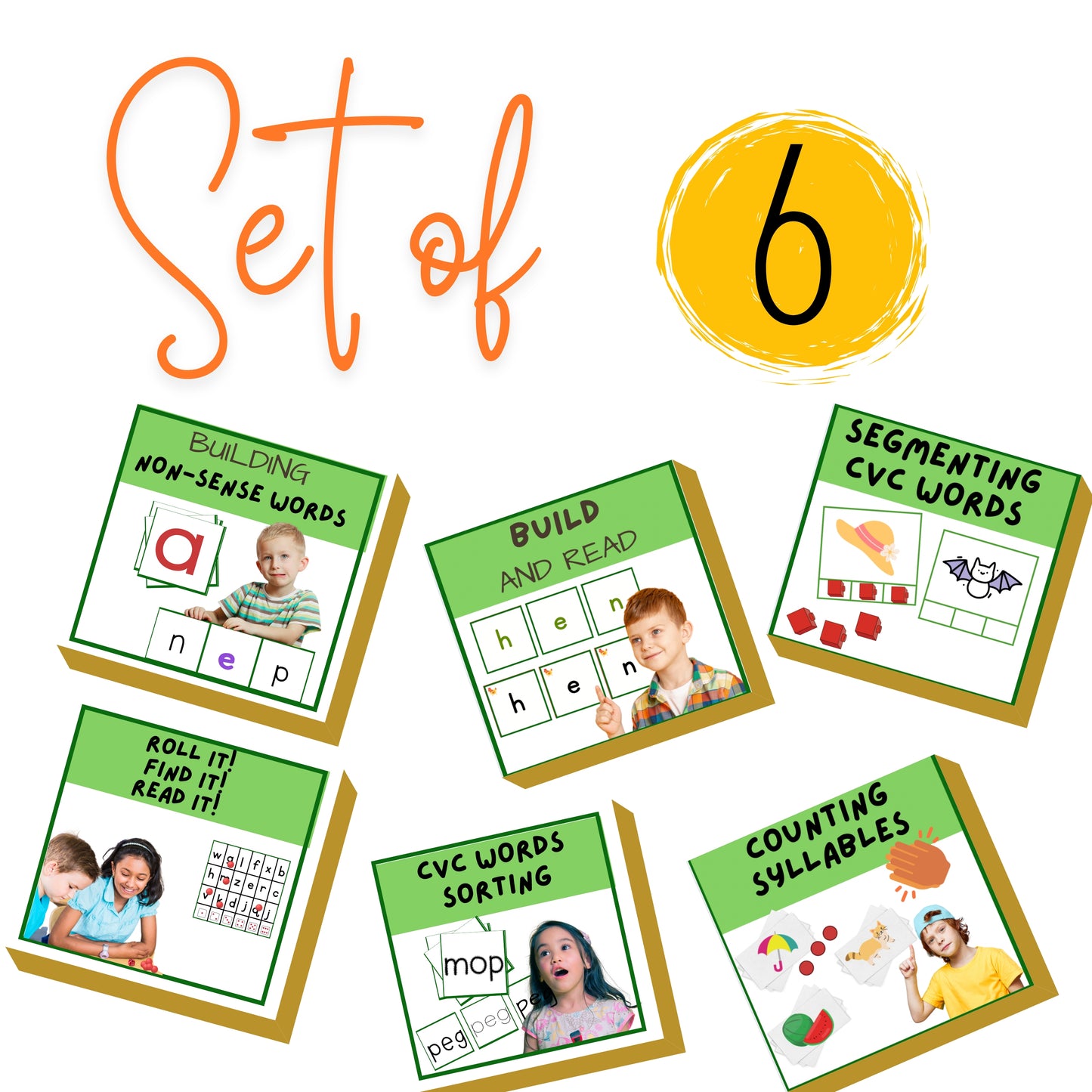
Games and activities included:
- Building nonsense words
- Build and read CVC words
- Segmenting CVC words
- Roll it, Find it, Read it (letters and sounds)
- Counting syllables
- CVC words tapping/sorting
This set supports:
• Blending and segmenting sounds
• Decoding CVC words
• Phonological awareness
• Accuracy and early word reading
• Confidence through repeated practice
How Educators Use This in Small Groups
These phonic games work as a structured warm-up before decodable book reading. They can also be used as the main activity for students who need more time with phonemic awareness before moving to connected text.
A typical 15-minute small group session might look like this:
⏱ Minutes 1–3: Sound activation. Start with “Roll it, Find it, Read it” to warm up letter-sound knowledge before any blending work. Fast, focused, and immediately engaging.
⏱ Minutes 4–8: Blending practice. Move into “Build and Read CVC Words” or “Building Nonsense Words.” Nonsense words are especially effective because they confirm students are decoding, not memorizing.
⏱ Minutes 9–12: Segmenting. “CVC Words Tapping/Sorting” or “Segmenting CVC Words” — students tap out each sound, then blend back. This builds the phonemic awareness that makes decoding automatic.
⏱ Minutes 13–15: Syllable awareness. “Counting Syllables” wraps up the session and bridges toward multi-syllable word reading.
The multi-sensory element — touching, moving, building — keeps struggling readers engaged in ways that worksheets often can’t. These games are particularly effective for intervention groups and students who need additional repetition to build automaticity.
→ See how to pair these games with decodable book reading in small groups
Perfect for kindergarten and early first-grade phonics instruction, small groups, and intervention.
→ Download free decodable books to pair with these games